English
A few years ago, I was driving on highway 151 from San Angelo back to Sweetwater, and I was going just a little too fast. Well, there was a police officer waiting for me on one of the hills where I could not see him, and of course once I saw him, it was too late to slow down. He turned on the flashing lights, and I knew I was caught. When I stopped the car, I was sitting in the front seat thinking of how I had messed up, and what I might be able to say to the police officer so that he would have mercy on me. I knew what happened next depended on his final decision.
That is an example of me submitting to the proper authority. If I had kept going, well, I probably wouldn’t be celebrating this Mass with y’all, but you could come visit me in the jail cell. I think for the most part, we don’t have any problem submitting to the authority of the police officer who pulled us over for driving too fast. We would prefer not to get caught, but if it happens, we recognize it is our own fault, and we need to take responsibility.
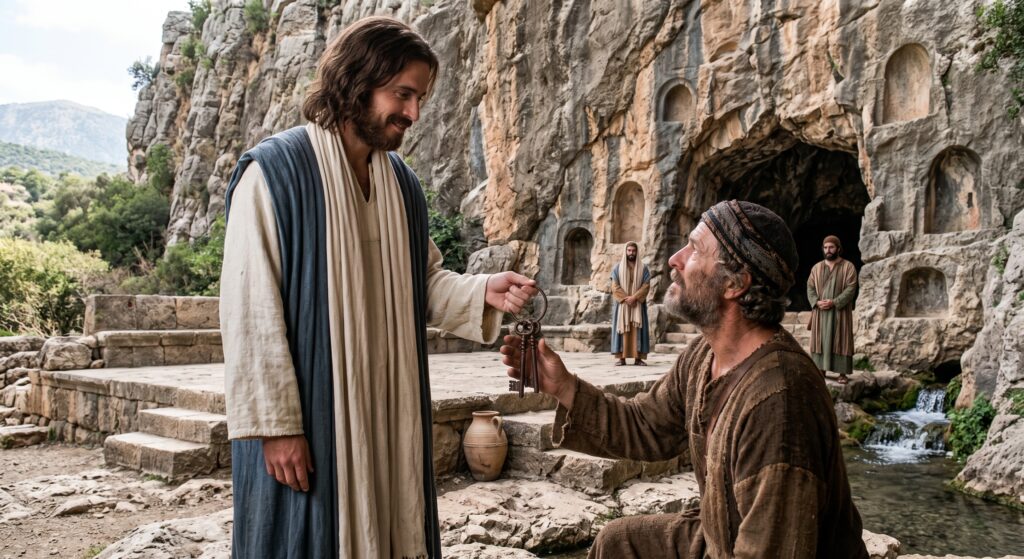
Peter is given authority by Jesus today. You are Peter, and on this rock I will build my church, and the gates of hell will not prevail against it. I give you the keys. Whatever you bind on earth will be bound in heaven, and whatever you loose on earth will be loosed in heaven. This image of authority that Jesus is giving to Peter is very familiar to a Jew. Look back to the first reading. Shebna was the steward, and he had the keys of the king. But he was not living a holy life, and so God prophesied through Isaiah that the keys would be taken away from him and given to Eliakim. The Pharisees were the ones who had the keys in the time of Jesus. When the elders made a declaration, the people had to follow it, unless they said it was something that needed further discussion. And Jesus takes that authority away from them and gives it to Peter first. He later gives authority to the rest of the disciples, but he begins with Peter.
This is why we recognize what the Pope teaches and we respect what he declares. Now a pope has only declared 2 things that we must believe in the last 200 years. We must believe that the Virgin Mary was conceived without original sin. And we must believe that the Virgin Mary was taken by God into heaven body and soul. Everything else the Pope has taught we are free to discuss. Now of course, our discussion must flow from what the Bible says and what the Church has taught since the beginning, as well as the tradition. This is how we respect the authority given by Jesus to the Pope today.
The best way to take this seriously today is to read what the pope has written, or listen to what he speaks, and then study it. If it sounds like something that we should not do, then it needs to be examined before we do it. And if we find that what he says is in agreement with the Bible and the tradition of the Church, then it seems reasonable for us to listen and follow the teaching as we respect the authority given to him by Jesus Christ.
Spanish
Hace unos años, conducía por la autopista 151 de San Angelo de vuelta a Sweetwater, y iba un poco demasiado rápido. Pues bien, había un policía esperándome en una de las colinas donde no podía verle, y por supuesto, una vez que lo vi, ya era demasiado tarde para frenar. Encendió las luces intermitentes y supe que me habían pillado. Cuando paré el coche, estaba sentado en el asiento delantero pensando en cómo la había liado y en lo que podría decirle al policía para que tuviera piedad de mí. Sabía que lo que pasaba después dependía de su decisión final.
Ese es un ejemplo de cómo me sometí a la autoridad correspondiente. Si hubiera seguido, probablemente no estaría celebrando esta misa con vosotros, pero podríais venir a visitarme a la celda. Creo que, en general, no tenemos problema en someternos a la autoridad del policía que nos paró por conducir demasiado rápido. Preferiríamos no que nos pillen, pero si ocurre, reconocemos que es culpa nuestra y tenemos que asumir la responsabilidad.
Hoy Pedro recibe autoridad de Jesús. Tú eres Pedro, y sobre esta roca edificaré mi iglesia, y las puertas del infierno no prevalecerán contra ella. Te doy las llaves. Todo lo que ates en la tierra será atado en el cielo, y todo lo que perdáis en la tierra será liberado en el cielo. Esta imagen de autoridad que Jesús da a Pedro es muy familiar para un judío. Mira atrás a la primera lectura. Sabna era el mayordomo y tenía las llaves del rey. Pero no vivía una vida santa, así que Dios profetizó a través de Isaías que las llaves serían arrebatadas y entregadas a Eliacim. Los fariseos fueron quienes tenían las llaves en tiempos de Jesús. Cuando los ancianos hacían una declaración, el pueblo tenía que seguirla, a menos que dijeran que era algo que necesitaba más discusión. Y Jesús les quita esa autoridad y se la da primero a Pedro. Luego da autoridad al resto de los discípulos, pero empieza por Pedro.
Por eso reconocemos lo que enseña el Papa y respetamos lo que declara. Ahora bien, un papa solo ha declarado dos cosas que debemos creer en los últimos 200 años. Debemos creer que la Virgen María fue concebida sin pecado original. Y debemos creer que la Virgen María fue llevada por Dios al cielo, cuerpo y alma. Todo lo demás que el Papa ha enseñado somos libres de discutirlo. Por supuesto, nuestra discusión debe derivar de lo que dice la Biblia y de lo que la Iglesia ha enseñado desde el principio, así como de la tradición. Así es como respetamos la autoridad que Jesús ha otorgado al Papa hoy.
La mejor manera de tomarlo en serio hoy es leer lo que el papa ha escrito, o escuchar lo que dice, y luego estudiarlo. Si parece algo que no deberíamos hacer, entonces debe examinarse antes de hacerlo. Y si encontramos que lo que dice está en concuerdo con la Biblia y la tradición de la Iglesia, entonces parece razonable que escuchemos y sigamos la enseñanza respetando la autoridad que le dio Jesucristo.
2 Comments
Hey Thanks Father Josh Gray
Thank you, Father Josh. Miss seeing you around San Angelo. Stay safe! 🙏💙🙏
Respectfully,
Terry Lucas